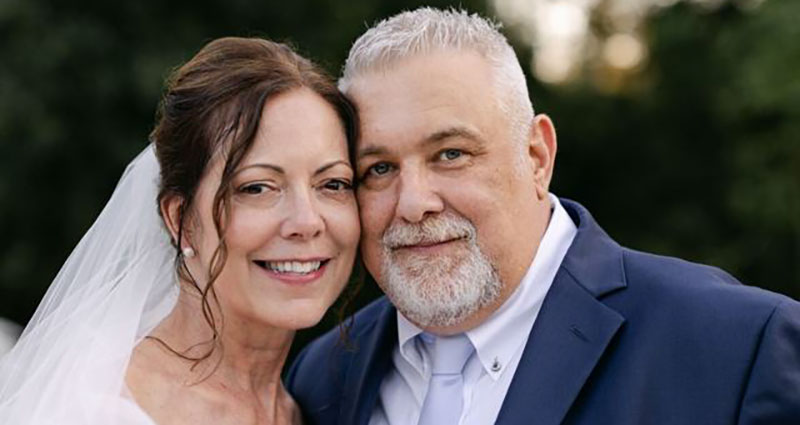
When Kelly Kelly thinks back to early 2024, she remembers feeling unusually tired and disconnected. She kept pushing through her days, working at a surgical practice, helping care for her aging mom and settling into life with her new husband. But something felt off.
Her family noticed changes too. She struggled to finish her sentences. At work, she couldn’t write down patient information.
“I couldn’t talk. I couldn’t form any words,” she recalls. Her daughter finally told her she needed to go to the emergency room.
On Feb. 6, Kelly went to the hospital near her home in Covington. She expected doctors to find something simple. Instead, she learned she had a tumor the size of a golf ball in her brain and lung cancer that had already reached Stage 4.
“It was hard to process,” she says. “I just knew there wasn’t a thing I could do about it except what the doctors told me to do.”
A Life-Saving Surgery and a Team Working Together
Kelly’s condition was urgent. Scans showed swelling in her brain, and her neurosurgeon performed surgery that same week.
With the immediate crisis stabilized, her oncology team mapped out a plan involving chemotherapy, immunotherapy, radiation and lung surgery. That treatment strategy led her to FMOL Health | Our Lady of the Lake in Baton Rouge.
Her oncologist recommended thoracic surgeon Dr. Nicholas LeBlanc at the Our Lady of the Lake Cancer Institute. For Kelly, that referral became a turning point.
“He said Dr. LeBlanc was the best in the state,” she says.
When Dr. LeBlanc performed her lobectomy, he discovered the cancer hadn’t spread to her lymph nodes. Kelly learned later that this was rare for cancer that had reached her brain. It gave her a chance she didn’t think she would have.
The Strength of a Coordinated System
Throughout her treatment, Kelly moved between care teams in Covington, Baton Rouge and Hammond for surgery, scans, immunotherapy and gamma knife radiation. What stood out to her was how smoothly everyone communicated.
“I’m so blessed by the care I received. The doctors took the time to familiarize themselves with my case and plan out their approach,” Kelly says. “Everyone stayed on the same page and there was no miscommunication. I think that played a big part in the success of my treatment.”
At Our Lady of the Lake, she felt supported at every point of care. Whether she was getting blood work or preparing for surgery, she appreciated the organization, the short wait times, and the kindness she encountered.
“People were so nice and so caring,” she says. “They played a big role in saving my life.”
Kelly also received support services, including counseling through the cancer program. That emotional guidance carried her through some of the darkest moments. She worried about her children, her new grandchild and her mother, who depended on her. Talking with her counselor helped her stay grounded and focused on healing.
Treatment Challenges and Triumphs
Kelly’s journey was not without setbacks. After a few rounds of immunotherapy, she developed severe pain in both feet, making it difficult to walk. The side effect passed, but she remembers it as one of the hardest parts of treatment.
Still, she stayed committed to the plan. She completed chemotherapy, continued immunotherapy, underwent gamma knife radiation, and recovered from brain and lung surgery. She returned to walking, working and living her day-to-day life.
Her most recent molecular test showed no detectable cancer cells.
“I’m zero percent,” she says.
After everything she endured, those words carried weight she could hardly describe.
Sharing Hope With Others
Now cancer-free, Kelly feels compelled to reassure others facing lung cancer. She often talks with patients she meets through work, encouraging them not to give up.
“There is hope,” she says. “Everybody is different. I just kept telling myself that. Nobody’s story is the same.”
Advances in treatment made a life-saving difference for her, and she wants people to know how far cancer care has come.
Awareness matters, Kelly says, especially for people who may ignore early signs or assume they aren’t at risk. She says her story is a reminder to others to listen to their bodies and seek care when something feels different.
“I remember reading people’s stories about their positive outcomes, and I found that to be uplifting. I think it’s good to hear about situations that go well,” she says. “Even when the diagnosis is Stage 4, that doesn’t necessarily mean it is a death sentence.”