
Blood cancers are among the most complex conditions to diagnose and treat. Leukemia, lymphoma and multiple myeloma each behave differently, and many have dozens of subtypes.
For patients, that complexity can feel overwhelming. At FMOL Health | Our Lady of the Lake Cancer Institute, the blood cancer team has built a program designed to simplify that journey and bring the most advanced therapies directly to the region.
The group’s approach is anchored in subspecialized care, rapid diagnosis, expanded clinical trial options and growing access to leading treatments such as CAR-T cell therapy. Together, these efforts are helping patients receive world class blood cancer care close to home.
A Team Built on Subspecialization
Blood cancers require expertise that goes far beyond a general oncology approach. Each disease comes with its own biology, its own treatment pathway and its own evolving science. That is why the team at Our Lady of the Lake has structured its program around subspecialized physicians who focus on specific cancers.
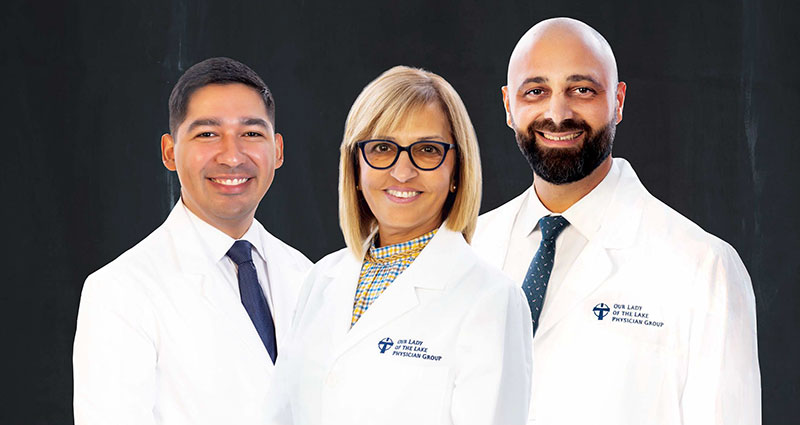
Hana Safah, MD, for example, cares primarily for patients with multiple myeloma and myeloproliferative neoplasms. She says, “I focus on these diseases from diagnosis to treatment, including clinical trials that are related to those areas.”
Nakhle Saba, MD, specializes in lymphoma and lymphoid leukemias. He notes that the pace of advancement makes subspecialty essential. “It is becoming impossible to keep up with all the advances and subtypes without subspecializing,” he says.
For Harry Sequeira, MD, subspecialty in acute leukemias allows him to give patients a more personalized plan from the start. “The fact that we are so specialized lets us choose treatment very precisely so patients get the best outcomes,” he says.
This structure means each patient is seen by a doctor whose training and daily focus align directly with their specific diagnosis.
Faster Diagnosis and More Personalized Treatment
Timely diagnosis is critical for many hematologic malignancies. Some cancers, such as acute leukemia or aggressive lymphoma, can worsen rapidly. The team has invested in faster diagnostic processes, allowing many patients to receive a clear diagnosis within days.
“You do not have the time to wait on a diagnosis when it is leukemia or a very aggressive lymphoma,” Dr. Safah says. “We are creating the ability to have the diagnosis made within a few days, and that is something you do not always see in community settings.”
Once a diagnosis is made, physicians look at genetic and molecular markers to guide treatment. This precision medicine approach helps determine which therapies are likely to be most effective, and it steers patients toward targeted therapies that spare healthy cells whenever possible.
Dr. Sequeira says this is now part of the first conversation he has with leukemia patients.
“We get the genetic footprint and classify that patient by risk,” he says. “The conversation has become more hopeful because we can personalize treatment in a safer way.”
CAR-T and the Rise of Cellular Therapy
Few advances have changed the outlook for blood cancers like cellular therapy. Treatments such as CAR-T therapy use a patient’s own immune cells, reengineered to recognize and attack cancer.
Dr. Saba leads the CAR-T program at Our Lady of the Lake Cancer Institute. He describes the treatment in simple terms: “We take part of the immune system, re-engineer the cells to fight the cancer and give them back. We are basically creating a small army.”
Success rates are significant. For certain aggressive lymphomas, CAR-T offers cure rates in the 40 percent range when other treatments have failed. Less aggressive lymphomas can see long-term disease control in 60 to 70 percent of patients. In multiple myeloma, CAR-T is showing some of the most promising results ever seen for a disease long considered incurable.
The team is now delivering CAR-T safely in outpatient settings, thanks to improved ways of preventing and managing side effects. New trials are launching as well, including next-generation CAR-T products and cellular therapies for severe autoimmune diseases.
Expanding Access to Care
While innovation moves quickly, access remains one of the biggest challenges across the Gulf South. Distance, cost and insurance approval can limit who can receive advanced treatment. The team is working to change that.
Dr. Saba says the biggest hurdles are insurance coverage and the ability of patients to travel. The Cancer Institute is partnering with legislators, housing resources and financial assistance programs to support patients who need CAR-T or transplant care.
Meanwhile, new clinical trials are expanding access even further.
“Trials help us give patients a newer potential standard of care, sometimes with covered cost,” Dr. Sequeira says.
The Power of Clinical Trials
Those clinical trials play a central role in blood cancer care. They open access to therapies that are still emerging, often years before they become standard treatment. In recent years, the Cancer Institute has expanded its clinical research portfolio, giving patients more opportunities to be matched with innovative therapies.
Dr. Saba calls clinical trials one of the three pillars of care.
“A robust clinical trial program brings the latest and greatest treatments to our patient population,” he says. These treatments often show the strongest early signs of long-term benefit, and in some cases, trial participation covers parts of the treatment cost, reducing financial barriers.
The team is also working closely with pharmaceutical partners to bring more trials to Louisiana, especially for minority and underserved populations who have historically had limited access.
For Dr. Safah, the goal is simple: “By bringing trials here, we make these treatments available for all,” she says.